


University : Al-Quds University
Tutor(s) : Prof. Dr. Yara Saifi
Project Description
At the end of June 2023, an estimated 110 million people remained forcibly displaced (UNHCR, 2023). A refugee may stay in refugee camps that are being constructed as an emergency response. However, they have become more than a simple temporary solution, with refugees spending significantly longer than they should. Refugee camps are being seen as an ephemeral city and refugees as passive objects of relief, this approach tends to dehumanize and victimize refugees who survived war and persecution to a safer space. UNHCR’s camp space management framework is based on a 50m by 40m “square-shaped” master plan, focusing on the “family unit” rather than individuals. This standardization approach alienates those not fitting the family model and fails to consider cultural and social differences, Thus, a standardization model that is suitable for all ethnicities and continents cannot give the exact solutions to different problems. Many refugee camps around the world have evolved and expanded into fully-fledged communities. This reflects a disjuncture between the camp’s operational needs and the refugees’ lived experience on the one hand and the camp design’s theories and practices on the other.
One of these refugee camps is Al-Za’tari camp in Jordan. Za’tari is considered the largest camp for Syrian refugees. It was mainly chosen as an intervention site because it reached its 10th anniversary in 2022. So, the refugee camp life span exceeded the planned and expected, resulting in many problems that negatively affected the lives of the refugees. Refugees navigate the imposed institutionalized top-down spatial organization by utilizing collective bottom-up approaches. This enables them to produce socially and culturally responsive patterns of urban living. These patterns reflect their recent housing experiences and allow them to find dignity, opportunity, and a sense of place through collaborative efforts. Learning from and building on what the refugees have been producing since the opening of the camp in 2012 was the main factor that shaped the design criteria and strategies. This will later support the design by challenging the top-down approaches implemented and forcing the camp into a new approach based on longer-term participatory solutions.
Reflecting on these collective acts will not only empower the refugees but also unify them under a single collective identity, with each refugee playing an active role in designing their built surroundings, and each inhabitant plays a central role in any decision that affects the organization of the space.
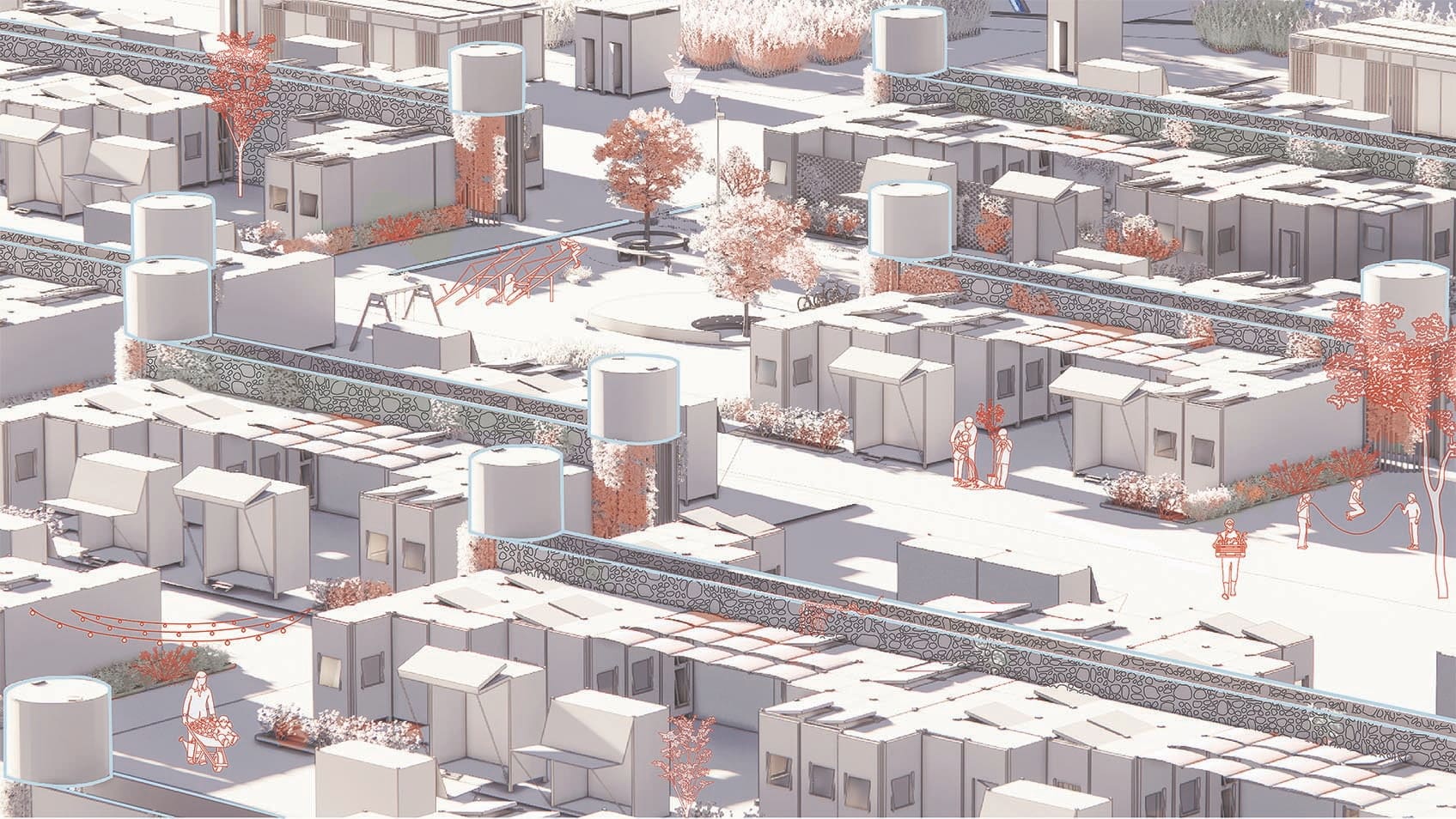
The camp is divided into 12 districts based on the UNHCR division. Intervention takes place in District 7 mainly because it’s one of the least developed areas in the camp and, therefore, contains a mix of caravan and tent shelters.
So, a new camp model based on three dimensions will be implemented.
Note: Folded shelters can be placed anywhere in the world for any refugees and are fully funded by the UN.
Utilising creek water
Floods frequently affect the camp in the winter, causing tent collapses and other health problems. Because the responsible institutions do not consider the design according to environmental and climatic conditions, providing water for every refugee throughout the year must be necessary.
Rainwater creeks that reach the camp were tracked through the analysis of the camp maps; the idea was to collect as much rainwater as possible through underwater wells that reach water tanks connected to the infrastructure wall and houses.
In the summer, when there’s no rain, water comes from a large tank raised from the earth’s surface by the UN; it goes through PVC pipelines, then to the underground wells, and from there to the water tanks and infrastructure walls then to the houses.
The infrastructure wall
A gabion wall which is 3m in height and 10m in width, through which water pipes from tanks, grey water pipes, and dry toilets extend.
The dry toilet
A dry bathroom system is available for every house. This system does not require a connection to a sewage system. It brings waste to a specific area between the infrastructure walls and converts it into natural fertilizer for agriculture.
Established in 2012, Tamayouz Excellence Award is an unaffiliated, independent initiative that aims to advance the profession of architecture academically and professionally. Tamayouz is dedicated to supporting aspirational and transformative projects that tackle local and global challenges and that are informed by a holistic understanding of context.